
Now the model chooses
It reads, summarizes and decides which brands fit the answer. There's no auction, no bidding, no way to buy the spot: whoever it can justify with what it found gets in.
It's not a suspicion: it can be measured. The module asks your market's questions in the assistants where your customer asks, saves what came back, and shows which questions your brand appears in, which ones it disappears from, and who is taking your place.
What's the best [your industry] company for an operation my size?
With the old search engine you could see the decline: your ranking fell, your traffic fell, someone noticed. In the AI's answer there's no second page and no ranking drop. There's only being in or being out. And the customer who never saw you also never knew you existed to search for.
It reads, summarizes and decides which brands fit the answer. There's no auction, no bidding, no way to buy the spot: whoever it can justify with what it found gets in.
There's no alert, email or dashboard telling you your brand dropped out. The answer simply moves on without you, and the conversation ends before it reaches your site.
The same question brings up different brands in ChatGPT, Gemini, Perplexity and Claude. Doing well in one says nothing about the others, which is why measurement needs to happen engine by engine.
Each round the module asks, reads the whole answer and stores what it found. What you open in the morning isn't an impression: it's a picture of what the AI has been saying about your brand, with a date and the source next to it.
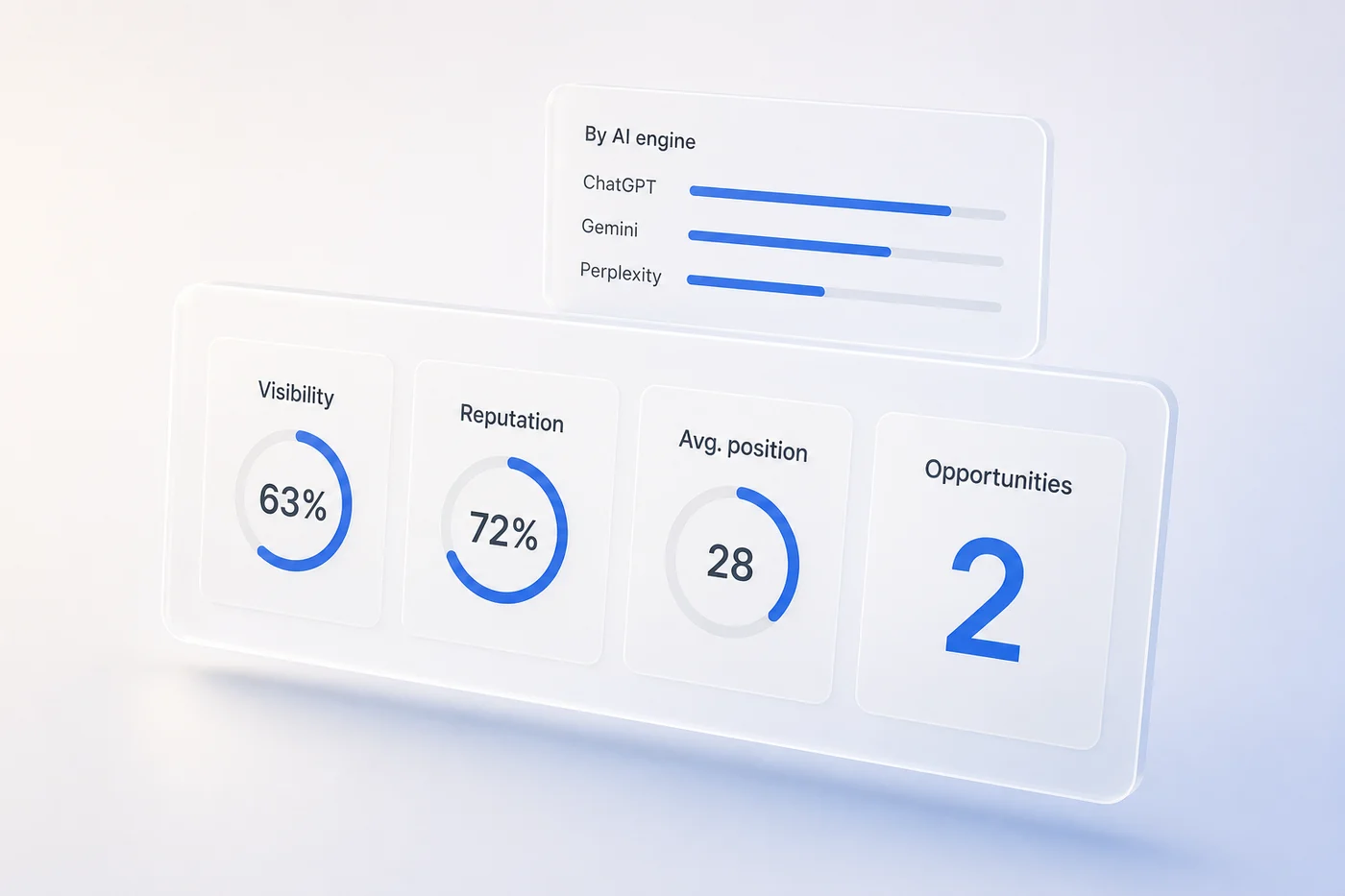
Out of every ten questions in your market, how many mention your brand. It's the number that sums everything up, and the only one you can track month by month.
Being mentioned isn't enough: how matters. The module separates praise from caveats and from comparisons where you show up as the pricier option.
Where in the answer you show up, and how much of the space among cited brands is yours compared to each competitor's.
Where the AI got what it said, and the list of questions you didn't appear in, which is where the next work is.
Measurement is done on each one separately, with the question written the way a customer would write it. No average that hides the engine where you're doing poorly.
The one with the largest reach, and the one that mixes memory with search the most. It answers by citing few brands and tends to repeat the same ones: whoever gets in, gets in to stay.
It pulls heavily from what Google already indexes, so it rewards well-structured pages and pages that answer the whole question, not just the title.
It always cites the source right in front of the user. It's the engine where you can most clearly see WHICH page made the AI talk about you, or about your competitor.
More conservative: it prefers to state what it can back up. Appearing here usually requires third party material, not just your own site.
The answer Google builds right into search. The collector already exists and is being calibrated. It goes live for customers as soon as the reading is verified.
An engine only starts counting once the collection is checked. Doubtful data doesn't become a metric here: we prefer the smaller, true list.
A sample measurement, run on the spot, on the engines that are up. You type in your site and see the result on this page: signing up only makes sense after you know the number.
Type in your industry and take the ready-made list. Paste it into ChatGPT tonight and see with your own eyes who gets cited: that is exactly what the module does, every day, on four engines.
What's the best [your industry] company?
What are the main [your industry] options in Brazil?
Is it worth hiring [your industry]? What are the pros and cons?
How much does [your industry] cost and what's included?
What's the cheapest [your industry] alternative without losing quality?
Compare the three best known [your industry] companies.
Which [your industry] company is best for a mid sized operation?
What should I watch out for when hiring [your industry]?
Who are the most trustworthy [your industry] companies?
What's the best [your industry] option for someone just starting out?
These are templates, not measurement: they serve as a starting point. In the product, questions come from your market and what your customers actually write.
None of them caricature the other side: SEO works, spreadsheets work, and chart tools are good for something. The point is where each one stops.
Without media budget, organic citation in the answer is the channel. Start by measuring five questions and writing for the two where you don't appear.
The team publishes, but nobody knows if that turned into a citation. Here the material comes from the measured gap, and the next round tells you if it worked.
Track line by line, by product and by region, with exportable history and the memory staying with the company.
It's not a raffle or an auction. The model needs to back up what it says, and it picks what it can justify with what it found. Four things matter more than the rest.
A mention in a media outlet, comparison, or forum is worth more than your own site: the model treats a third party as a witness and you as an interested party.
When three places describe you the same way, the model gains confidence to state it. A description that changes with each channel weakens the citation.
Text that answers directly, with the question in the title and the answer right below, is easier to cite than a nice looking institutional page.
In a category that changes fast, the model favors this year's material. A 2019 page with no update loses to a smaller competitor's.
This is where most visibility tools stop: they deliver the chart and leave. Here, the gap found already comes out as a task, and the task already comes out as published material, because published material is what the next round will find.
Measure my brand for freeEach step is a piece of content published from a measured gap. The chart doesn't rise on its own: it rises when someone writes what was missing.
The module shows the exact question, the engine it was asked on, who was cited in your place, and the page that backed up that citation.
With what needs to exist, where it needs to exist, and the priority: the gap that appears in three engines is worth more than the one that appears in one.
Two weeks later the same question is asked again. Either your brand made it into the answer, or it didn't, and that shows up in the chart, not in a meeting.
Name, website, and which market you're in. That's how the module knows which questions make sense.
The system suggests the ones your customer would ask; you remove, add, and select two to four competitors to compare.
The first round comes out right away. From then on, it repeats on its own, at the frequency you chose.
Stop writing in the dark: the topic comes from the question where the brand didn't show up, and the result of the piece appears in the next round.
Find out which competitor the AI is delivering to the customer before the first meeting, and with what argument.
See how the market describes the category and where your proposition is being misread, without waiting for quarterly research.
Visibility, reputation, position, sources, and opportunities: exportable.
Why that page doesn't become a source, and what's missing from it.
The material that fills the gap, built from what the engines showed.
No one needs to remember to open another dashboard. When the brand drops out of an answer, the alert reaches where the team already is.
Web search costs different prices on each engine, and Rovemark passes on the difference instead of charging the average. Whoever wants volume measures on Perplexity; whoever wants Gemini's answer pays what it costs. The choice is up to whoever pays.
900 measurements, each with the full answer stored
The free plan starts with 1,000 credits a month. On Perplexity that's 50 measurements; on Gemini, 10. You can find out if you're in or out without a card, choosing where to spend.
Measure my brand for freeNo. SEO competes for position in a list of links the user still has to choose from; here the choice has already been made by the model before any click. It changes what is measured (citation, not position), changes who decides (the model, not the index) and changes the work: what gets AI to cite you tends to be material that backs up a claim, not an optimized title. Whoever already does SEO well starts ahead, but it's not the same thing.
You choose: hourly, every six hours, twice a day, daily or weekly. The default is daily, which is enough to see change without wasting credit: an AI's answer doesn't change from morning to afternoon, it changes when someone publishes something.
As many as your balance can handle: the count is per question measured, not per registered brand. In practice most people track their own brand and two to four competitors, because comparison is exactly what gives the number meaning.
It helps. The agency starts working with the exact question that left you out and the page that got your competitor cited, instead of trying to guess. And the result of what it publishes shows up in the next round, dated.
What your company accumulates here is stored in Cerne with your key: questions, collected answers, history. It comes out whole the day you want it, and it never becomes anyone's model training data.
Definitions short enough to be cited, including by an AI asked about it.

Each one solves a front, and all write to the same memory. See the others and how they fit with this one.