
AI forgets with every conversation
You explain the business, the tone, and the constraint every time. The next day, from scratch, and the result gets worse because the context was summarized in a rush.
Core is where the operation's discoveries live: the price a competitor charges, the objection that always comes up, the decision already made. What one module learns today, another already knows tomorrow, and looking it up is the platform's lowest-cost operation.
Collection found: competitor A lowered its entry plan from R$ 199 to R$ 179 on August 14.
Propagation example. A fact you write by hand is never overwritten by automatic deduction: the owner has the final say.
The difference between a set of tools and a system is shared memory. It is what makes August's work matter in December, and what one area learned reach another without a meeting.
You explain the business, the tone, and the constraint every time. The next day, from scratch, and the result gets worse because the context was summarized in a rush.
The person who knew why that decision was made resigned. The decision still stands and nobody remembers why.
Sales knows the objection, marketing does not. What one discovered on Tuesday, the other discovers again alone a month later.
It is not a conversation transcript: it is a short fact, in five categories, that you can read on one screen and correct with your finger. What should not be there, you delete.
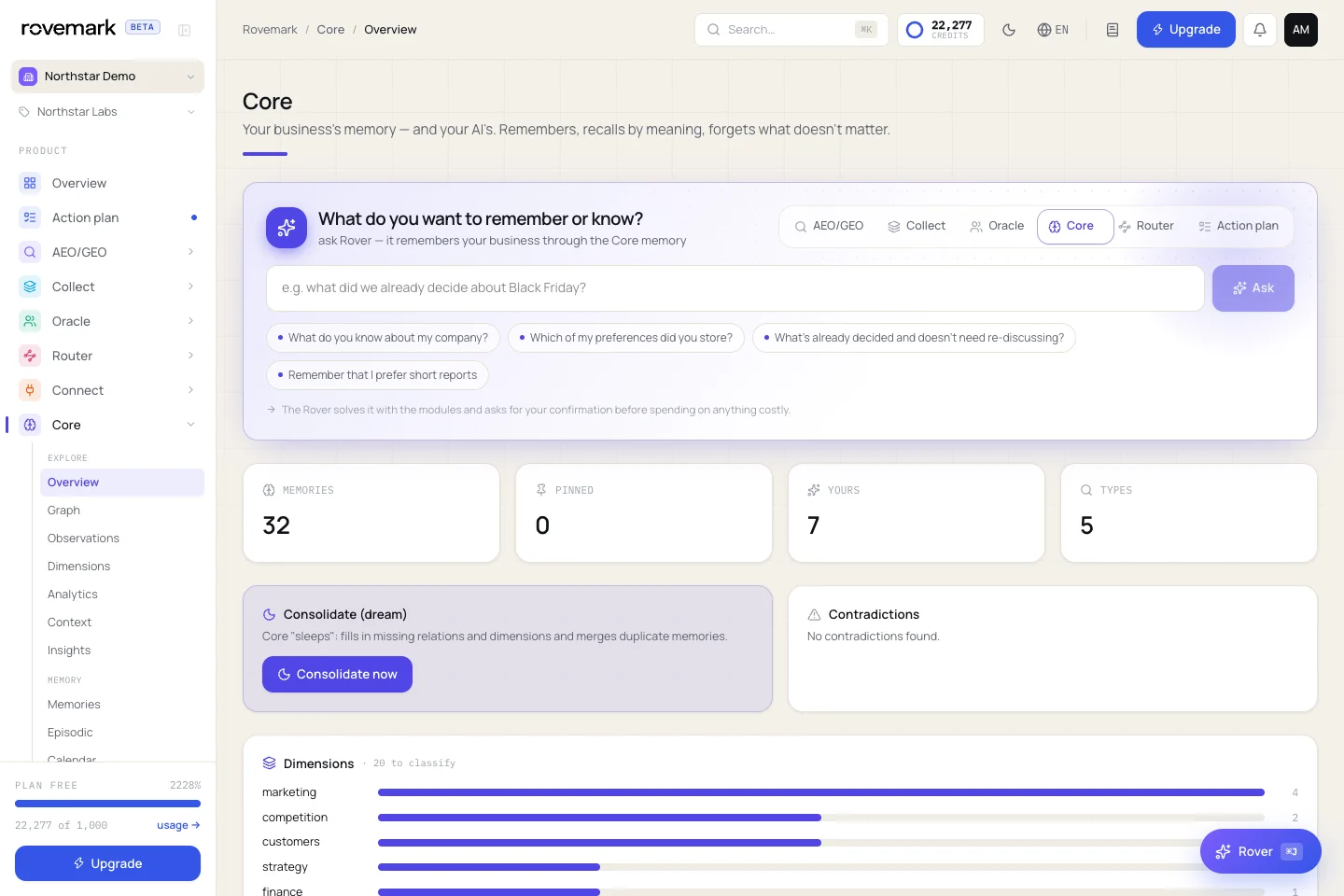
About you, about the company, preferences, market, and decisions. Categories narrow enough for you to find what you need without searching.
Every fact can be corrected or removed, and what you write by hand is never overwritten by automatic deduction.
Four credits. It is the lowest-cost operation here, and it is what other modules trigger on every request.
It is not one memory per module: it is the same one, written by everyone and read by everyone. It is what makes the system a body.
AI memory usually fails in two ways: by storing everything until you cannot find anything, or by contradicting itself. The four rules exist to prevent both.
"Prefers reports on Friday" fits. A paragraph of conversation does not. Good memory is what you can read in full on one screen.
When a fact changes, it replaces the previous one instead of coexisting with the contradiction. The old version is kept so you can undo it.
Automatic deduction never overwrites what the owner wrote by hand. If you corrected it, it is corrected, and it stays that way.
It is not a partial export or hostage to a format. The memory leaves complete, on the day you decide.
A shared document works, a huge prompt works, and chatbot memory works. The point is what survives over time and staff turnover.
What the company does, who it sells to, what is no longer up for debate. Five lines already change the outcome of everything that comes next.
Every collection, every test, and every measurement adds a new fact. You review what came in and correct what is wrong.
The entire memory fits on one screen precisely so it can be read. You delete what has become outdated.
Stop revisiting old decisions and repeating context to every new person who joins.
Receive work that already starts with the right tone, constraint, and history.
Start knowing what the company has already learned, instead of discovering everything again over six months.
In five categories, editable, with date and source.
What that fact said before, so you can undo it.
Everything, in one file, whenever you want.
When an important fact changes, a price, a decision, the notice reaches the place where the team already is.
Querying memory is the cheapest operation on the platform, because it is what the other modules do all the time. What costs more is when Core reasons about it: finding contradictions, consolidating, synthesizing the profile.
The most frequent operation is also the cheapest, by design: a request that queries memory uses 4 credits, versus 20 to 130 for a measurement in an AI engine.
See all plansThe idea is similar; the difference is who it belongs to and who can see it. Here, the memory belongs to the company, encrypted with the company key, read by every module and fully exportable. The assistant's belongs to the account of whoever talked to it, stays in there and disappears when the person leaves.
You correct or delete it, and the correction applies from that point on. A manually written fact is never overwritten by automatic inference: if you said it is so, it is so. And every change keeps the previous version, so it can be undone.
That is the risk of any automatic memory, and the answer here is SHORT facts: one line, not a transcript. The entire memory fits on one screen precisely so it can be read and reviewed in five minutes a month.
Anyone you authorize. The memory belongs to the company, with permissions per person, and the record shows who wrote or changed each fact.
No. The entire memory leaves in a file, on the day you decide. It is not a partial export or a format hostage. Staying should be a choice, not a prison.
Each module writes what it learned here and reads from here before working. It is the difference between six tools on the same bill and one system.

Each one solves a front, and all write to the same memory. See the others and how they fit with this one.